
Learn · FaceLab
Loud Snoring and Daytime Exhaustion — Understanding Sleep Apnea
Loud snoring every night. Tiredness that no amount of sleep can fix. A partner who has watched you stop breathing in your sleep. Together, these symptoms often add up to a treatable condition called sleep apnea.
At FaceLab, sleep apnea is diagnosed and treated by Consultant Chest Physicians alongside our maxillofacial team — Sri Lanka's first integrated sleep medicine service within a facial-and-dental institution.
Performed at ourThe Shoppes at City of Dreamsclinic, Colombo — Unit No. L8-37, Level 8, The Shoppes at City of Dreams, No. 1, Justice Akbar Mawatha, Colombo 02, Sri Lanka
In one sentence
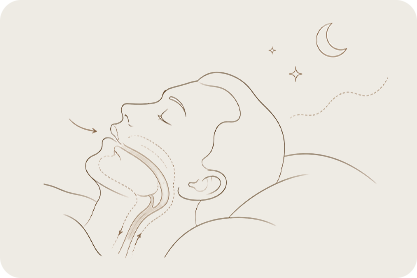
Sleep apnea is when your airway repeatedly closes during sleep — experienced as snoring, exhaustion, and never feeling rested.
When to consider a sleep study
You don’t have to be sure you have sleep apnea before getting checked. If any of the following apply to you, a sleep study is the next step.
- Loud, chronic snoring — especially if your partner has noticed pauses in your breathing
- Daytime exhaustion that doesn’t improve with more sleep
- Waking up gasping, choking, or short of breath
- Morning headaches or a dry mouth most days
- Difficulty concentrating, irritability, or mood changes
- High blood pressure, atrial fibrillation, or type 2 diabetes that responds poorly to treatment
- Witnessed apneas — a partner has seen you stop breathing during sleep
How sleep apnea is diagnosed and treated at FaceLab
Every patient is assessed by a sleep medicine specialist before any treatment decision. The standard pathway runs in four stages.
- 1
Specialist consultation
A detailed history, physical examination, and discussion of your symptoms with our sleep medicine consultant. We assess your airway, weight, neck circumference, and risk factors — then decide whether a sleep study is needed and which type would be most informative.
- 2
Sleep study
A home-based study using a portable monitor, or an in-clinic overnight study, depending on your case. The study measures your breathing, oxygen levels, heart rhythm, and how often your airway closes during sleep.
- 3
Diagnosis and tailored treatment plan
Your sleep medicine consultant reviews the study results and builds a treatment plan that fits you — not a single default. For most patients this combines two or more approaches, and may involve our maxillofacial team if surgical correction is the right answer.
- 4
Treatment and ongoing follow-up
We don’t fit and forget. Sleep apnea treatment needs review — comfort, daily use, and long-term effectiveness all matter. We bring you back at planned intervals to refine the plan as needed.
Why FaceLab’s sleep medicine is different
Most sleep services in Sri Lanka are diagnostic. Patients get a sleep study, a CPAP prescription, and are sent home. FaceLab is built differently — we offer the full range of treatment options, integrated under one roof.
Consultant Chest Physician-led care
Sleep medicine at FaceLab is led by board-certified Consultant Chest Physicians (MBBS, MD Respiratory Medicine) with specific sleep medicine training — not a general practitioner with a sleep interest, and not a diagnostic-only service.
More than just the standard sleep mask
CPAP — short for Continuous Positive Airway Pressure — is a bedside machine that keeps your airway open through a mask. We fit it for patients who can use it, and offer custom oral appliances or surgical correction for those who cannot.
Custom oral appliance therapy
An oral appliance is a custom-fitted dental device worn during sleep that holds your lower jaw forward and keeps your airway open. We design these in-house from your own dental impressions — a true alternative to CPAP for mild to moderate sleep apnea.
Surgical correction via our maxillofacial team
For some patients, jaw advancement surgery is the right answer — not a workaround. Our maxillofacial team performs these procedures in-house, in coordination with our sleep medicine consultants. This combination is rare in Sri Lanka.
One coordinated team across diagnosis, dentistry, and surgery
Sleep apnea often involves multiple specialties — chest medicine, dentistry, maxillofacial surgery. At FaceLab these specialists work together on every case. No referral chains, no repeating your story.
Why you shouldn’t ignore sleep apnea
Untreated sleep apnea isn’t just about being tired. The repeated drops in oxygen and disturbed sleep compound over years into serious health risks — most of which are reversible if the apnea is treated.
- High blood pressure — often resistant to medication until the apnea is treated
- Atrial fibrillation and significantly increased risk of stroke
- Type 2 diabetes and difficulty managing blood sugar
- Heart attack and heart failure
- Memory problems and reduced cognitive performance
- Microsleep at the wheel — a marked increase in road accident risk
- Reduced libido and erectile dysfunction
- Depression and persistent low mood
Frequently Asked Questions
Simple snoring is annoying but generally harmless. Sleep apnea is different — your airway actually closes for ten seconds or more, dozens or hundreds of times a night. The signs that distinguish them are witnessed pauses in breathing, gasping or choking on waking, severe daytime exhaustion, and morning headaches. If any of these apply, a sleep study is worth doing.
We can suspect sleep apnea from your symptoms — but we cannot grade its severity without measurement. A sleep study tells us how many times per hour your airway closes, how low your oxygen drops, and what kind of sleep apnea you have. That information decides whether you need CPAP, an oral appliance, or surgical correction. Treating without a study is guessing.
CPAP works brilliantly when patients can tolerate it — but roughly half can’t, long term. Alternatives include custom oral appliance therapy, positional therapy, and surgical correction of the airway. At FaceLab we offer all of these. The right choice depends on your sleep study results and your anatomy.
Sleep apnea surgery — most often jaw advancement — is a well-established procedure performed in carefully selected cases. It is most appropriate for patients whose airway anatomy is a primary driver of their apnea, and those who cannot tolerate non-surgical treatment. Success rates in well-selected patients exceed 85%. At FaceLab the procedure is performed by our maxillofacial surgical team in coordination with our sleep medicine consultants.
Weight loss helps. For some patients with mild apnea linked to recent weight gain, losing ten to fifteen percent of body weight can resolve the condition. For others — particularly those with significant anatomical contributors or longstanding severe apnea — weight loss alone is not enough. We discuss this honestly in your consultation.
Many patients notice a difference within the first week of effective treatment — better sleep quality, less daytime tiredness, fewer morning headaches. Full benefit typically takes four to eight weeks as your sleep rebalances. Cardiovascular benefits accumulate over months.
Continue reading
Our care for this
Related explanations
Have a specific case in mind?
Share your situation with our team on WhatsApp, or book a consultation at our The Shoppes at City of Dreams clinic.