
Learn · FaceLab
Missing Teeth and Failing Dentures — Dental Implants Explained
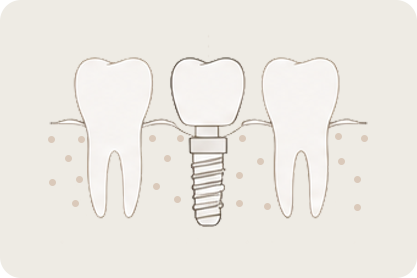
If you have lost a tooth or your dentures are no longer working, dental implants are the modern way to replace what is missing — small titanium fixtures anchored into your jawbone that act as new tooth roots, supporting teeth designed to last decades.
Whether you have lost a single tooth, struggle with loose dentures, or need a full reconstruction — every dental implant at FaceLab is placed by a maxillofacial surgical team and planned in 3D before any surgery, supported by our in-house Protomed CMF lab.
Performed at ourThe Shoppes at City of Dreamsclinic, Colombo — Unit No. L8-37, Level 8, The Shoppes at City of Dreams, No. 1, Justice Akbar Mawatha, Colombo 02, Sri Lanka
In one sentence
A dental implant is a titanium fixture anchored into your jawbone to replace a missing tooth — designed to last decades.
When you might need a dental implant
- A single missing tooth from injury, decay, or an earlier extraction
- Several missing teeth where a bridge is no longer a good option
- Dentures that move, click, or make eating and speaking awkward
- A full arch of teeth to be rebuilt (All-on-4 or All-on-6)
- An older implant that has failed and needs replacing
- Significant bone loss in the upper jaw — where standard implants are not an option (we offer zygomatic implants for these cases)
- Smile rehabilitation combined with broader aesthetic or functional work
How implant treatment works at FaceLab
Every implant case at FaceLab is planned digitally before any surgery happens. The exact pathway varies by complexity, but a standard implant journey runs in four stages.
- 1
Consultation and 3D planning
A 3D X-ray (CBCT) and digital scan of your mouth, followed by a detailed clinical assessment. For complex cases, our in-house lab (Protomed CMF) designs a custom surgical guide or a patient-specific implant from your own scan data.
- 2
Surgical placement
The implant is placed under local anaesthesia. Sedation is available if you would prefer it. For guided cases, a 3D-printed surgical guide ensures the implant is positioned exactly as planned. A single implant typically takes under an hour.
- 3
Healing period
Three to six months of healing as your jawbone gradually fuses with the implant — a natural biological process called osseointegration. For All-on-4 and immediate-load cases, a temporary fixed set of teeth can be fitted on the same day as surgery.
- 4
Your final teeth
A custom crown, bridge, or full set of teeth is designed digitally and crafted in premium ceramic or zirconia — colour-matched to your existing teeth and shaped to fit your bite and smile naturally.
What makes FaceLab's implant care different
Every dental implant at FaceLab is supported by five capabilities that most general dental clinics in Sri Lanka do not bring together under one roof. Together, they make implant care more predictable, faster, and possible for cases that would otherwise need a referral elsewhere.
Maxillofacial-specialist-led placement
Your implant is placed by a maxillofacial surgeon — a fully-qualified surgical specialist — not by a general dentist who places implants as one part of a broader practice. For complex anatomy, revision work, full-arch reconstruction, or any case where the unexpected may happen, that distinction matters.
Fully guided 3D digital surgery
Your implant is planned in three dimensions before any surgery happens. A custom 3D-printed surgical guide is produced in-house so the implant can be placed within fractions of a millimetre of the planned position. The result: more predictable outcomes, shorter surgery, and less swelling afterwards.
In-house custom implants via Protomed CMF
Off-the-shelf implants come in fixed sizes. For complex anatomy or revision cases, our in-house digital lab (Protomed CMF) designs implants from your own 3D scan and prints them to fit precisely — a capability rarely available outside of a teaching hospital in Sri Lanka.
Zygomatic implants for severe bone loss
If you have been told you need extensive bone grafting before implants can be considered, zygomatic implants may be an option. They anchor into the cheekbone instead of the upper jaw, often skipping the grafting altogether and shortening treatment time by months.
PEEK custom facial implants for combined work
When implant work is combined with facial aesthetic goals — chin, jaw, or cheek shaping — we offer patient-specific PEEK implants designed from your own anatomy. Lightweight, biocompatible, and shaped precisely for you, coordinated with our facial cosmetic surgery team.
When implants may not be right for you
Dental implants are well-established, but they are not the right answer for every patient. A thorough consultation rules out anything that could affect the outcome before treatment is planned.
- Active gum disease — we'll need to treat and stabilise this first
- Not enough bone in the jaw — manageable with grafting or zygomatic implants
- Heavy smoking — significantly lowers success rates; stopping beforehand is strongly recommended
- Uncontrolled diabetes or other conditions that affect healing
- Pregnancy — non-urgent procedures are deferred until after delivery
- Young patients still growing — implants are usually placed only after late adolescence
Frequently Asked Questions
There is no upper age limit. What matters is your general health, the quality of your bone, and your medical history — all assessed during consultation. Many of our implant patients are in their 60s, 70s, and beyond.
Not having enough bone is one of the most common reasons patients are turned away elsewhere. We have two routes: rebuild the bone with grafting before placing the implant, or — for severe upper-jaw bone loss — use zygomatic implants that anchor into the cheekbone and skip the grafting altogether.
The implant is placed under local anaesthesia, with sedation available if you'd prefer. Most patients report less discomfort than they expected — often describing recovery as easier than a complex tooth extraction.
A standard implant takes 3–6 months from placement to final crown — this includes a healing period as the bone fuses with the implant. All-on-4 and immediate-load cases can fit a temporary set of teeth on the same day as surgery, with the final teeth fitted once healing is complete.
With proper care, the implant itself is designed to be permanent and can last a lifetime. The crown or set of teeth on top typically needs review every 10–15 years depending on wear. Regular gum maintenance is the single biggest predictor of long-term success.
Zygomatic implants have been performed for over 20 years for patients with severe upper-jaw bone loss. They are technically demanding and should only be placed by a maxillofacial surgeon experienced in the technique — which is the team that performs them at FaceLab.
Continue reading
Have a specific case in mind?
Share your situation with our team on WhatsApp, or book a consultation at our The Shoppes at City of Dreams clinic.